Anaesthesia Breathing Circuits
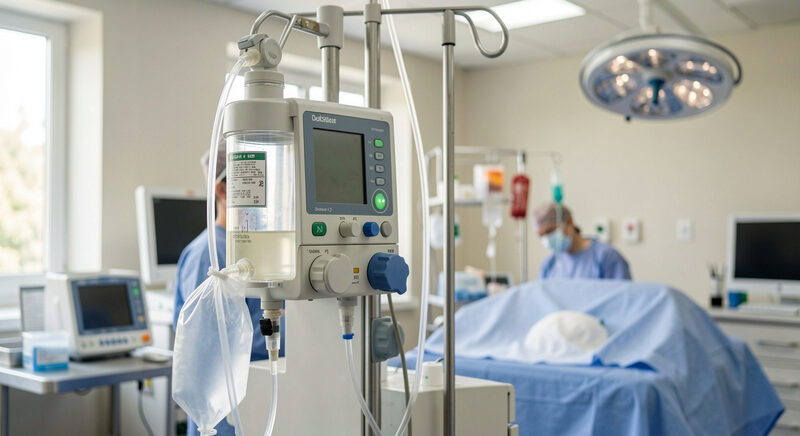
An anaesthesia breathing circuit carries the gas mixture from the anaesthesia machine to the patient and removes carbon dioxide from what the patient breathes out. Unlike a ventilator circuit, it often lets the patient rebreathe part of each breath, which saves anaesthetic agent and helps warm and humidify the gas. This guide explains the circle system that most operating theatres use, the simpler Mapleson arrangements, and what the soda lime absorber does.
What is an anaesthesia breathing system?
A breathing system is an assembly of components that delivers gases from the anaesthesia machine to the patient's airway. When those components are arranged as a loop, it is called a circle system. The loop contains a fresh gas inlet, a reservoir bag and usually a ventilator, two one-way valves, corrugated tubing, a Y-piece, an adjustable pressure limiting valve and a canister of carbon dioxide absorbent. Gas travels one way around the loop: from the patient, through the expiratory valve, through the absorber and back to the inspiratory side.
How does the circle system remove carbon dioxide?
The absorber canister holds soda lime, a granular mixture that is mostly calcium hydroxide with a small amount of sodium hydroxide and water, held together by silicates so the granules do not crumble. Carbon dioxide reacts with the soda lime and is trapped as carbonate, a reaction that gives off heat and water. Because the reaction is exothermic, the canister can warm up during use, and the same process warms and humidifies the gas passing through it. A pH indicator in the granules changes colour as the absorbent is used up, which is how staff judge when to change it. As a rough figure, 100 grams of soda lime can absorb around 26 litres of carbon dioxide.
Why do the one-way valves and fresh gas inlet matter?
Unidirectional flow is what makes a circle efficient. One valve sits on the inspiratory side and one on the expiratory side, and their positions keep gas moving the same way around the loop. The fresh gas inlet, where oxygen, air, nitrous oxide and the volatile agent enter, is placed so that fresh gas does not pass straight to the patient without first joining the loop. When these rules are followed, the same gas can be reused after its carbon dioxide is removed, and the fresh gas flow can be kept low. At higher fresh gas flows the exact layout matters less, because fresh gas flushes the loop; at low flows the arrangement is what keeps rebreathing safe.
What are Mapleson systems and when are they used?
Mapleson systems are simpler, valveless arrangements in which the reservoir bag, the tubing and the fresh gas inlet are placed differently to control how much the patient rebreathes. They have no absorber, so they rely on a high enough fresh gas flow to wash out carbon dioxide. They are light and portable, which suits induction, short cases, remote sites and some paediatric work where a circle would be awkward. The trade-off is higher gas consumption and less warming of the inspired gas than a circle provides.
How are circuits chosen for adults and children?
In adults, a circle system with a full size canister is standard, and low flow anaesthesia is common because the loop conserves agent and heat. In children, the smaller tidal volumes and higher respiratory rates make dead space and circuit volume more important, and the resistance of valves and absorbers is less well tolerated. Lighter paediatric circle systems with low resistance valves and low dead space connectors are used to keep the benefits of rebreathing without adding work of breathing. The ventilator breathing circuits guide covers the same ideas of dead space and compliance from the intensive care side.
What is checked on an anaesthesia circuit before a case?
The pre-use check follows the loop from the machine to the patient. Confirm the absorbent is fresh enough and the indicator is the right colour, the canister is seated and sealed, the valves move freely and seat correctly, the reservoir bag is the right size and undamaged, and the tubing has no splits. Then check that the circuit holds pressure and that the adjustable pressure limiting valve behaves as expected. The same loop is examined for condensate, since the water produced by the absorber and by the patient can collect in a dependent limb. The water traps guide describes how that liquid is handled when it gathers.
What the absorbent indicator tells you
Soda lime is sold with a pH indicator that changes colour as the granules take up carbon dioxide, so the canister gives a visible sign of how much absorbent remains. The indicator is read across the canister, not at the surface: exhausted absorbent is often visible first near the inlet, while the rest still looks fresh. A canister that has changed colour through most of its volume is due for a change, and a canister that has been left open to the air will exhaust itself even without use. Staff also check for channeling, where gas finds a path through the granules rather than passing through the whole bed, which leaves unused absorbent and shortens the useful life. The pre-use check includes the indicator, the seal and the fill level together.
A habit that prevents most circuit problems
Read the circuit as one object before each case rather than trusting the last check. Follow the gas path with your eye, from the fresh gas inlet around the loop to the Y-piece, and confirm each valve, seal and connection along the way. When something looks dry or discoloured, or when a bag feels stiffer than usual, stop and find out why. A minute spent tracing the loop before induction is cheaper than discovering a leaking canister or a stuck valve once the patient is asleep.