Humidification in Invasive Ventilation
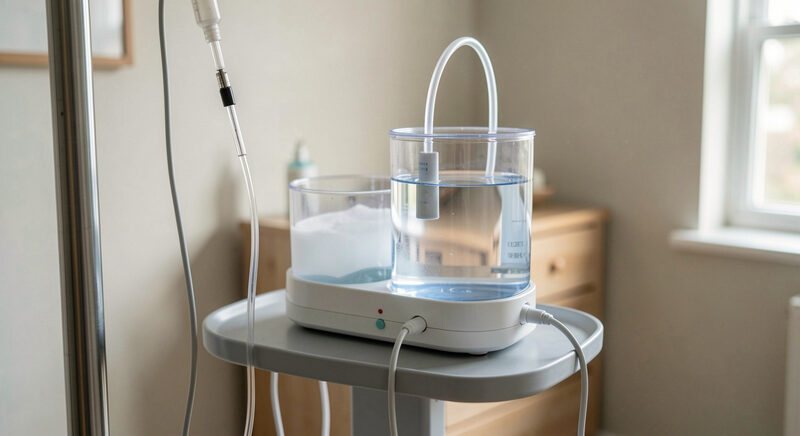
An endotracheal tube bypasses the nose and upper airway, so the breathing circuit has to warm and humidify the gas that reaches the lungs. If it does not, secretions thicken, the tube can block and the airway lining is exposed to cold dry gas. There are two ways to do the job: active humidification, which adds heat and water from a heated chamber, and passive humidification, which recovers heat and moisture from the patient's own exhaled gas. This guide explains how each works and when one suits a patient better than the other.
How does active heated humidification work?
An active humidifier passes the inspiratory gas over heated water in a chamber, so the gas picks up heat and vapour before it travels to the patient. The chamber sits on the inspiratory limb, and the gas temperature is controlled by a heating base and, in many systems, by a heated wire in the tubing. A temperature probe near the Y-piece feeds back to the control unit so the set point is held as flows change. Most modern devices target a gas temperature near 37 degrees Celsius at the airway, which is close to body temperature and to full saturation.
What is the main problem with active humidification?
The gas leaves the chamber warm and saturated, and as it cools along the inspiratory limb it releases water as condensate. That is the subject of the heated wire circuits guide, which shows how condensate increases with minute volume and respiratory frequency and how room temperature can defeat a correctly set circuit. Condensate in a limb is treated as contaminated and is not returned to the humidifier. The clinical answer is not to abandon active humidification but to control it: keep the limb warm with a heated wire, hang the tubing so water drains to a trap, and empty the traps as part of the routine. The water traps guide covers that handling.
How does passive humidification compare?
A heat and moisture exchanger recovers heat and water from exhaled gas and returns them on the next breath, with no power, no water and no controls. It is light and simple, which suits transport, short procedures and many anaesthetic cases. Its weakness is that it recovers rather than creates moisture, so its performance depends on the patient and the settings. Efficiency falls as tidal volume rises, and the device adds resistance and dead space to the circuit. The HME filters guide sets out how much moisture different HMEs return and why two similar devices can differ several fold.
Which patients need active humidification?
Active humidification is generally preferred where ventilation is prolonged, where secretions are thick or copious, where minute volume is high, and where the patient is hypothermic or has a low body temperature to protect. It is also the usual choice for patients with a large air leak around the tube, because an HME cannot recover moisture that never returns through it. Passive humidification is often enough for short ventilation, for transfers and for patients with normal secretions on modest settings. The decision is made per patient and reviewed, because a patient who starts on an HME may later need active humidification as the clinical picture changes.
What does the bedside check look like?
For active humidification, check the chamber water level, the set temperature and the probe reading, the condition of the heated wire and the level in the water traps. Look at the patient's secretions, which are the best sign of whether humidification is adequate: thin and easy to clear is the aim, thick and tenacious suggests more humidity is needed. For passive humidification, check the device is seated and the right size, that it is changed at the specified interval, and that airway pressures have not risen in a way that suggests the medium is loading. In both cases, the check is quick and it prevents the slow problems that build over a shift.
What does the evidence say about circuit changes?
Review work on ventilator circuits, humidification and ventilator associated pneumonia notes that circuits do not need to be changed more frequently than weekly for infection control purposes, and that more frequent changes may be associated with a higher incidence of pneumonia rather than a lower one. That finding shapes the routine: the circuit and its humidification devices are maintained and inspected, not replaced on a fixed short cycle. The related question of whether to reuse devices intended for single use is a separate matter, governed by reprocessing rules rather than by convenience. When in doubt, the manufacturer's instructions and local policy set the change interval.
What temperature and humidity targets mean
Active humidification aims to deliver gas close to body temperature and fully saturated with water vapour at the airway, which is why many devices hold a set point near 37 degrees Celsius. Absolute humidity is measured as milligrams of water per litre of gas, and a fully saturated gas at body temperature carries around 44 milligrams per litre. The exact target matters less than the direction: too little humidity thickens secretions and can block the tube, while too much raises the risk of condensate and of water reaching the airway. Passive humidifiers return only part of what the patient breathes out, so their output depends on the breath and on the settings. Reading the patient's secretions is the everyday way to judge whether the target is being met.
What to do at the start of a shift
Treat humidification as a system rather than a setting. Confirm which method the patient is on, check the water level, temperature and traps for active humidification, or the device and its change date for passive, and look at the secretions. If the patient is on an HME and the secretions are thickening, or if condensate keeps returning despite a heated wire, raise it as a clinical question rather than simply repeating the same checks. Recording what you found and what changed gives the next clinician the pattern, and it turns humidification from a background task into a decision that is made deliberately.