CPAP, BiPAP and NIV Masks
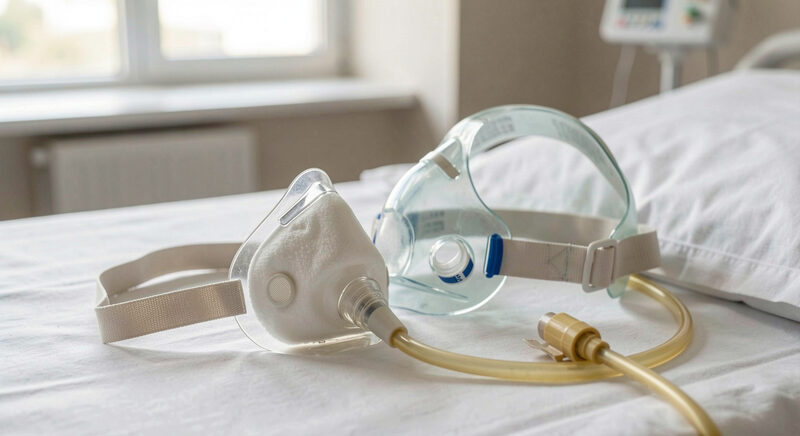
Non-invasive support delivers pressure to the airway through a mask rather than a tube, so the interface is the therapy. A mask that seals well and fits comfortably lets the set pressure reach the lung; a mask that leaks or presses too hard turns a helpful treatment into a struggle. This guide explains how CPAP, BiPAP and NIV interfaces differ, what fit and leak mean for the patient, and how to judge an interface at the bedside.
What is the difference between CPAP, BiPAP and NIV?
CPAP holds one steady pressure throughout the breathing cycle. It is used to keep the upper airway open in obstructive sleep apnoea and to support oxygenation in other conditions, and it does not itself assist each breath. BiPAP applies a higher pressure during inspiration and a lower one during expiration, so it supports the work of breathing as well as holding the airway open. NIV is the general term for breathing support given through an interface instead of an invasive tube, and it can be delivered as CPAP or as bilevel support depending on the machine and the settings.
Which interface suits which patient?
Interfaces fall into a few families. Nasal masks cover the nose only and suit patients who breathe through the nose and prefer a lighter seal. Oronasal, or full face, masks cover the nose and mouth and are used when nasal breathing is not enough or when the patient needs higher pressures. Nasal pillows sit at the nostrils and reduce contact with the face. Helmets enclose the whole head and avoid facial pressure, at the cost of more dead space and noise. Total face masks cover the whole face. Each has a place, and the choice is usually made by trying the least obtrusive option that holds the pressure the patient needs.
Why does fit matter so much?
Pressure that leaks around the interface does not reach the airway, so a poor seal means the patient receives less support than the machine displays. Leak also causes noise and eye irritation, dries the mouth and nose, and can trigger arousals that fragment sleep. Fit is a balance: too loose and the mask leaks, too tight and it presses on the bridge of the nose or the cheeks, which leads to skin breakdown and to the patient removing it. The aim is the smallest amount of strap tension that keeps the seal, checked with the therapy running rather than with the mask off the face.
How is an interface assessed at the bedside?
Start with the patient's comfort and the leak reading on the device. Look at the skin where the mask contacts the face, especially the bridge of the nose, and check for redness that does not fade. Listen for leak around the seal at the pressure in use, and watch the patient's breathing pattern for signs that the support is not being delivered. Confirm the headgear is the right size, the cushion is clean and undamaged, and the tubing is not pulling the mask to one side. When a patient cannot tolerate a mask, the answer is often a different interface or a different size rather than more pressure.
How does humidification fit into non-invasive support?
Non-invasive therapy blows a stream of gas across the nose and mouth, which dries the mucosa and can make the patient feel congested. A heated humidifier added to the circuit warms and moistens that gas, which improves comfort and tolerance, particularly at higher pressures and in cold rooms. The humidification guide covers the active and passive options, and the heated wire circuits guide explains why a heated limb reduces the condensate that would otherwise collect in the tubing.
What are the common problems and their causes?
Most interface problems have a mechanical cause. Leak around the eyes usually means the mask is too large or sits too high. Redness on the nose bridge means the straps are too tight or the mask is the wrong shape. A patient who removes the mask in the night may be reacting to leak, to dryness or to pressure, and each has a different fix. Mouth leak during nasal therapy can be reduced with a chin strap or by switching to an oronasal interface. Working through these causes in order, rather than simply tightening the mask, is what makes non-invasive therapy tolerable enough to continue.
How pressures are set and titrated
CPAP and BiPAP pressures are set to the patient's response, not to a fixed number. CPAP is usually started low and increased until the airway is held open and the work of breathing eases, within the range the device and the interface can tolerate. Bilevel support has two settings, an inspiratory pressure and an expiratory pressure, and the difference between them, along with the timing of the change, shapes how much support the patient receives. Higher pressures need a better seal, so the interface and the pressure are adjusted together. The readings on the device are watched alongside the patient's breathing pattern, oxygen level and comfort, because a pressure that leaks away is not the pressure the patient receives. Each change is recorded so the next clinician knows what has been tried.
What to check before leaving the bedside
Confirm the interface is the right type and size, the seal holds at the set pressure, and the leak reading is within the range the device expects. Check the skin contact points and adjust the straps to the least tension that keeps the seal. Make sure the humidifier, if used, is set and the tubing is supported so it does not pull on the mask. Then ask the patient how it feels, because comfort predicts whether the therapy will still be in place in the morning. A mask that is comfortable and sealed is worth more than a higher pressure that leaks away.