Nebulizer Kits and Aerosol Delivery
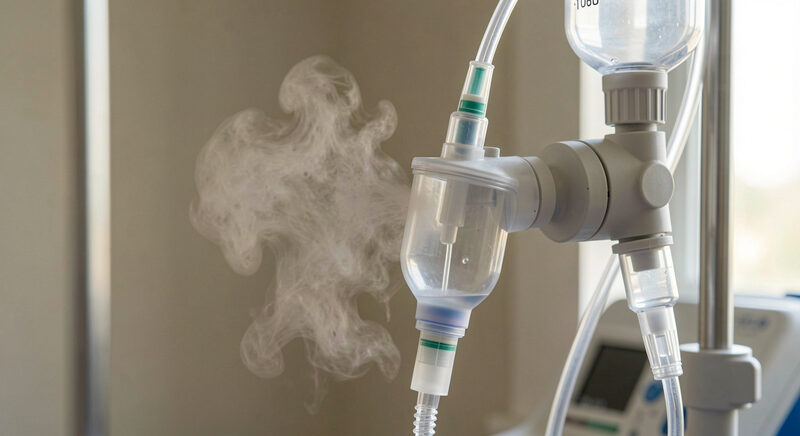
Giving a drug as an aerosol to a ventilated patient is harder than it looks. The nebulizer has to turn a liquid into droplets, those droplets have to survive the tubing, the humidifier and the airway, and only a fraction of the dose reaches the lung. The choice of nebulizer and its position in the circuit change that fraction more than most people expect. This guide explains the three main nebulizer technologies, where they should sit, and what the evidence says about delivery.
What are the three types of nebulizer?
Nebulizers are divided by how they make the aerosol. A jet, or pneumatic, nebulizer uses a high pressure gas flow to break a liquid into droplets, and it is the oldest and most common type. An ultrasonic nebulizer uses a vibrating crystal to shake the liquid into a mist. A vibrating mesh nebulizer pushes the liquid through a fine mesh that vibrates at high frequency, producing a consistent droplet size. All three are used during mechanical ventilation, and all three place the drug in the circuit rather than in the patient's mouth.
Why does placement in the circuit matter?
The drug has to travel from the nebulizer to the lung, and the further it travels and the more it is diluted, the less arrives. Studies of aerosol delivery during ventilation have compared nebulizer positions and found that placing the device before the humidifier, on the dry side, delivers more drug than placing it near the Y-piece, because less is lost to the humidifier and the tubing. The effect was larger for vibrating mesh nebulizers than for jet nebulizers. The general finding is that the closer a nebulizer sits to the ventilator, the more drug reaches the patient, and the closer it sits to the Y-piece, the less.
How does bias flow affect delivery?
During ventilation the circuit carries a continuous flow, known as bias flow, even between breaths. That flow can carry aerosol away from the patient before it is inhaled, and higher bias flow reduces delivery. Bench studies comparing bias flows of 2 and 5 litres per minute found that the higher flow delivered less drug to the lung model. Where the ventilator allows it, reducing bias flow during nebulization, and synchronizing nebulization with inspiration, are ways to increase the dose that reaches the patient without increasing the dose placed in the chamber.
How do the technologies compare?
In head to head bench tests, vibrating mesh nebulizers have generally outperformed jet nebulizers, delivering several times more drug to the lung model in some studies. The advantage is not without caveats: one comparison found that vibrating mesh performance was less predictable, with random failure to empty the chamber in a proportion of runs, while jet nebulizer delivery was more affected by fill volume and by humidity. The practical conclusion is that the technology sets the ceiling, but placement, fill volume and bias flow decide how close a given setup gets to it.
What role does humidity play?
A heated humidifier adds water vapour to the circuit, and that vapour can affect both the nebulizer and the droplets. Jet nebulizers placed on the wet side of the humidifier are more sensitive to humidity and to fill volume, while breath enhanced jet designs and vibrating mesh devices are less affected. Placing the nebulizer on the dry side avoids contaminating the humidifier chamber and reduces the loss of drug to condensation. This is why the humidification guide and this one are read together: the humidification setup is part of the aerosol delivery system, not a separate concern.
How does the drug reach the lung?
Once aerosolized, the droplets are carried by the gas stream through the circuit, past any filter or heat and moisture exchanger, through the endotracheal tube and into the airway. Large droplets are lost in the tubing and in the humidifier, and only a fraction of the nominal dose reaches the lower airway. The bacteria and viral filters guide explains how a filter at the Y-piece affects the gas path, and the HME filters guide notes that a device at the airway adds dead space and resistance. If a filter sits between the nebulizer and the patient, it can capture a large part of the dose, so the placement of all the components has to be planned together.
What happens after the treatment
When the treatment ends, the nebulizer chamber is inspected to see how much liquid remains. A chamber that has not emptied as expected means the dose did not reach the patient, and the reason is worth finding before the next dose is given. The chamber is then removed or left in place according to the manufacturer's instructions, and if it stays in the circuit it is capped so the circuit remains closed. The filter or heat and moisture exchanger near the patient is checked, because a device that captured a large part of the aerosol may need attention. The ventilator settings that were changed for the treatment, such as a reduced bias flow, are returned to their previous values. Recording the drug, the dose, the nebulizer type and its position gives the next clinician a record of what was delivered and how.
The filter at the ventilator's expiratory port is worth a look at the same time, since aerosol that was not inhaled is carried there and can coat the medium over repeated doses. The guide to expiratory filter blockage after nebulization describes the pressure changes to look for.
What to check before starting a nebulizer
Confirm the nebulizer is the type and size the protocol calls for, that it is seated correctly and not leaking, and that its position in the circuit is the one that delivers best for your setup. Set the gas flow or the device settings as the manufacturer specifies, and note the fill volume, because delivery depends on it. Check that nothing between the nebulizer and the patient will trap the drug, and consider whether bias flow can be reduced during treatment. Then watch the patient and the chamber: if the chamber does not empty as expected, the dose has not been delivered, and the treatment needs to be repeated rather than assumed to have worked.