Ventilator Expiratory Filters
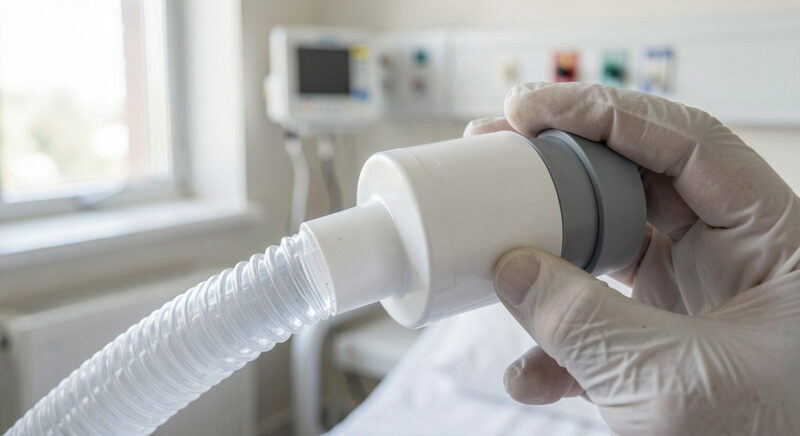
A ventilator expiratory filter is a bacterial and viral filter fitted at the machine end of the expiratory limb, where exhaled gas re-enters the ventilator. It stops what the patient breathes out, including droplets and any nebulized drug that was not inhaled, from reaching the expiratory valve, the flow sensor and the room. Because every breath leaves through it, a filter that becomes wet or coated raises expiratory resistance and can trap gas in the lungs.
What does a ventilator expiratory filter protect?
The expiratory limb carries exhaled gas back to the ventilator. On many intensive care ventilators the expiratory valve, which holds the set positive end expiratory pressure, and an expiratory flow sensor sit just behind the expiratory port, before the gas leaves through an exhaust outlet. Without a filter, everything the patient exhales passes through those parts and out into the room. A filter at the port protects three things at once: the machine from contamination, the volume and flow readings that depend on a clean sensor, and the people near the bed from exhaled aerosol. In a 2015 lung model study of mucolytic drugs, the authors state that bacterial filters were placed on the expiratory limb to reduce contamination in the ventilator.
Where does the expiratory filter sit in the circuit?
The filter sits on the ventilator's expiratory port, at the far end of the expiratory limb. That position keeps the filter away from the airway, so it adds nothing to the dead space the patient rebreathes, and it places it after any water trap on the limb. Some ventilators take a dedicated filter inside a housing at the expiratory port, others accept a standard disposable filter on the outside, and the manufacturer's instructions say which type the machine expects. The wider picture of filter positions, at the Y-piece, on the inspiratory limb or on the expiratory limb, is set out in the guide to bacteria and viral filters in breathing circuits.
How is it different from an HME filter at the Y-piece?
An HME filter sits between the Y-piece and the airway, where inspired and expired gas both pass through it. It returns heat and moisture and filters in both directions, but it adds dead space and resistance to every breath and captures aerosol given through the circuit. An expiratory filter does no humidifying work: it sees only exhaled gas and is the usual choice alongside active heated humidification. A 2021 narrative review of aerosol delivery during invasive ventilation reports that filter HMEs placed between a nebulizer and the patient reduced delivered drug by more than 90 percent in one bench comparison, and its checklist says to remove a filter HME from that position during treatment. The expiratory filter sits downstream and only collects the part of the dose that was never inhaled.
What happens to exhaled aerosol without an expiratory filter?
Only part of a nebulized dose is inhaled. The review of aerosol delivery via invasive ventilation by Lin, Fink and Ge, published in Annals of Translational Medicine, notes that as much as 30 percent of aerosol is typically inhaled and that a greater proportion is exhausted, raising concern about second hand exposure of staff and families. It cites surveys in which protective filters were used on the expiratory limb in only 24 to 40 percent of cases, and an in vitro study by Ari and colleagues that measured how much drug reached the ventilator exhaust with and without one.
| Expiratory limb setup | Share of the administered dose found at the exhaust |
|---|---|
| No filter | As high as 45 percent |
| Filter with efficiency above 99.99 percent at 2.0 microns | 4 to 6 percent |
| High efficiency filter, 99.97 percent at 0.3 microns at 100 L/min | 0.25 percent |
On that basis the review encourages a high efficiency particulate air, or HEPA, filter on the expiratory limb, and at least an electrostatic filter during aerosol therapy where a HEPA filter is not available. The guide to nebulizer placement and bias flow explains why so much of a dose never reaches the lung in the first place.
Why do expiratory filters block?
Two things load an expiratory filter: water and drug. Exhaled gas is warm and close to saturated, and in a circuit with a heated humidifier it carries a large amount of water vapour. As that gas cools on its way back to the machine, vapour condenses on the tube wall and in the filter housing, and a wet filter medium resists flow more than a dry one. This is why the limb is hung so that condensate runs to a trap rather than towards the port, as described in the guide to water traps and condensate in the limb.

Nebulized drugs add a second load. The 2021 review warns that a HEPA filter may increase the resistance of the system after aerosol therapy, and that viscous drugs may form crystals on it. A lung model study by Hu and colleagues, published in 2015 in the Journal of the Formosan Medical Association, tested bacterial filters on the expiratory limb with a jet nebulizer run for 15 minutes every 45 minutes, up to the 45th dose or until the filter obstructed. In that model the maximum pressure reached about 39 cmH2O with 10 percent acetylcysteine, against about 3.5 cmH2O with 2 percent hypertonic saline, and with acetylcysteine a pressure drop above 4 cmH2O appeared earlier and grew with the number of doses.
How does a blocked expiratory filter show on the ventilator?
A filter that resists flow on the expiratory side slows exhalation. If the next breath starts before the lungs have emptied, gas is trapped and the end expiratory pressure rises above the set PEEP, a state called intrinsic PEEP or auto-PEEP. In volume controlled modes, peak and plateau pressures climb. In pressure controlled modes, the delivered tidal volume falls. On the flow waveform, expiratory flow fails to return to zero before the next breath, and raised pressure in the chest can reduce venous return and blood pressure. Hu and colleagues concluded that expiratory resistance, auto-PEEP and the ventilator waveform should be monitored continuously when aerosolized 10 percent acetylcysteine is given, and the 2021 review lists increased airway resistance after aerosol therapy as a sign that may indicate a blocked expiratory filter.
When is the expiratory filter changed?
The change interval is the one given in the filter's instructions for use and in local policy, because each filter is labelled for a maximum duration of use under the conditions it was tested in. Beyond the scheduled change, the filter is replaced early when it is visibly wet, when expiratory resistance or auto-PEEP rises without another explanation, and after nebulized treatment if the pressures suggest it has loaded. Changing it briefly opens the expiratory side, so the new filter is ready in hand and the old one goes straight into clinical waste. A run of early changes points to a cause upstream, such as condensate that is not being trapped or a drug that is coating the medium.
What to check at the bedside
Confirm that a filter is fitted at the expiratory port and that it is the type the ventilator manufacturer specifies. Beads of water or visible deposits inside the housing mean it is loading. Check that the limb drains towards its trap rather than towards the port. Before and after each nebulized treatment, note the peak and plateau pressures, the exhaled tidal volume and the expiratory flow trace, and perform an expiratory hold if auto-PEEP is suspected. If the numbers move, look at the expiratory filter before concluding that the lungs have changed, and record the change date so the next shift knows how long it has been in place.
Questions readers ask about expiratory filters
Is an expiratory filter the same as an HME filter?
No. An HME filter sits at the airway, humidifies and filters in both directions, and adds dead space. An expiratory filter sits at the ventilator's expiratory port, filters only exhaled gas and adds nothing to the dead space of the breath.
Can a blocked expiratory filter harm the patient?
Yes. Resistance on the expiratory side traps gas, raises auto-PEEP and airway pressures, lowers tidal volume in pressure controlled modes and can lower blood pressure. That is why pressures and the flow trace are checked after every nebulized treatment.
Does the expiratory filter reduce the dose the patient receives?
No. It sits downstream of the patient and collects only aerosol that was not inhaled. A filter HME between the nebulizer and the airway is a different matter: in the bench comparison cited by the 2021 review, it cut the delivered dose by more than 90 percent.